
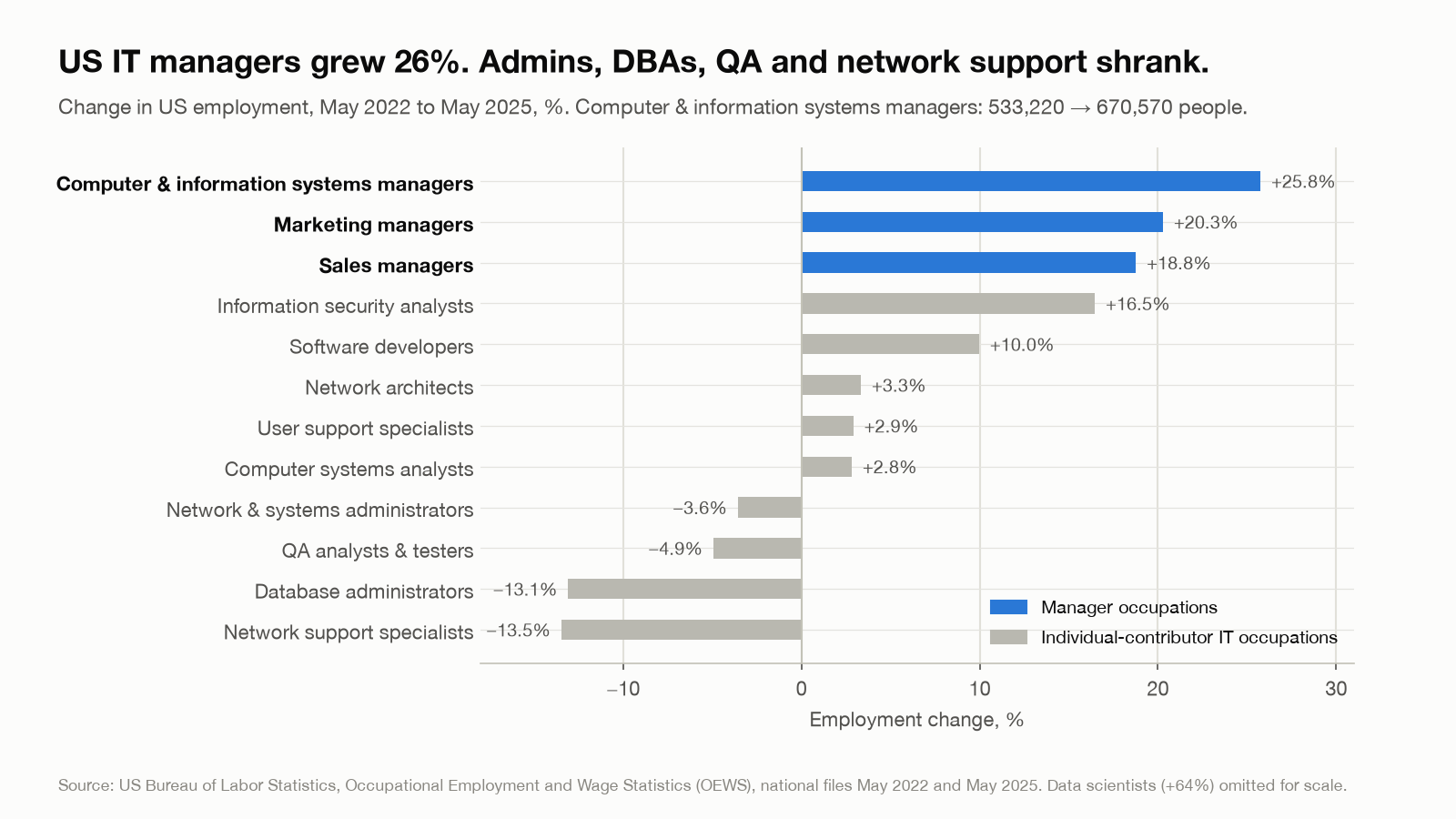
CIO and IT manager jobs grew 26 %. The managers under them got cut.
The US employs a quarter more IT managers than in 2022, and the UK now advertises more Head of AI jobs than CTO jobs. Below them, Big Tech removed a layer of managers and the hands-on roles shrank.
This post is the entry point of the AI-era IT jobs series.
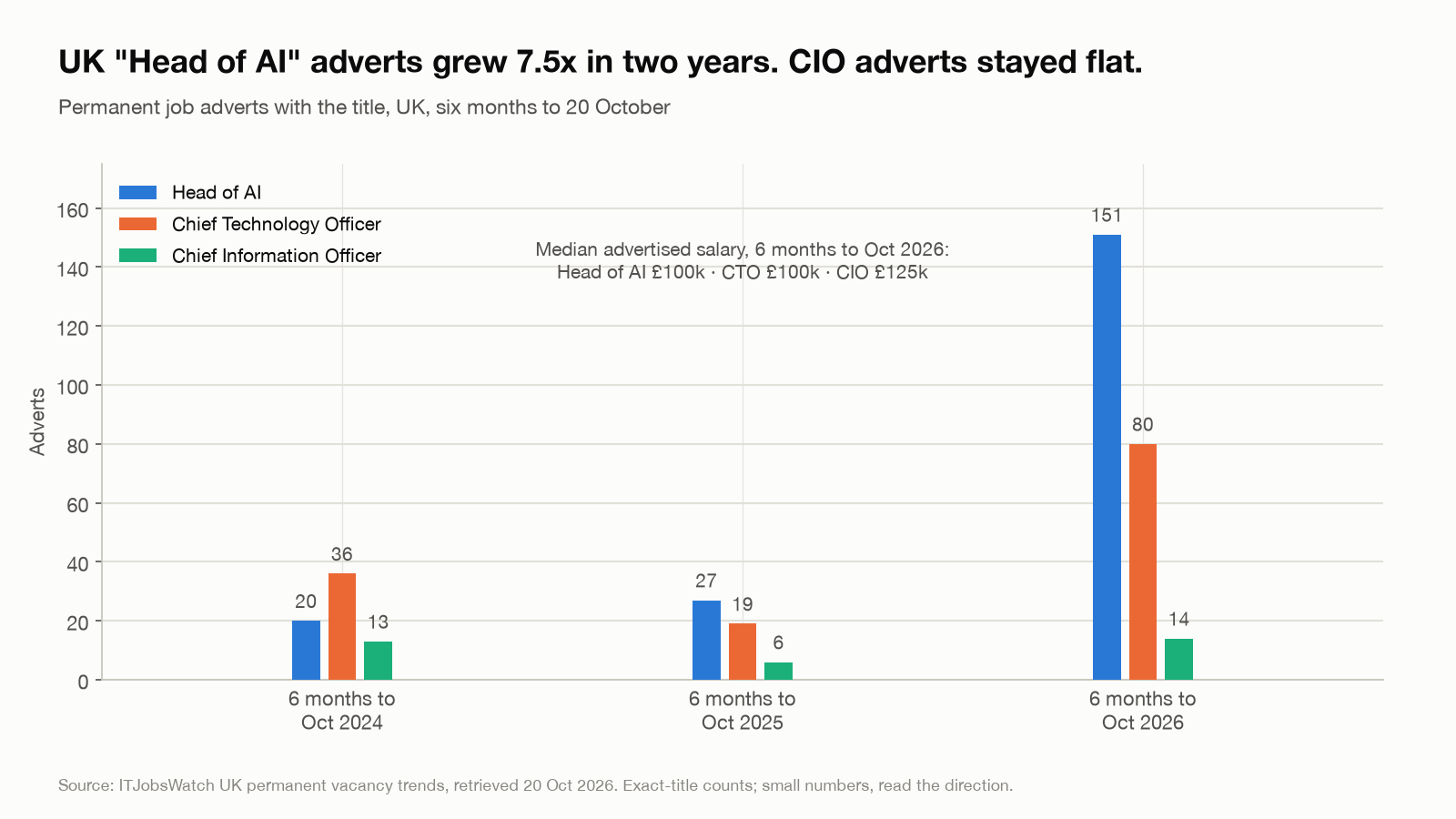
In May 2025 the US employed 670,570 computer and information systems managers, 26 % more than three years earlier [BLS OEWS, 2025]. Of the IT occupations I track, only data scientists grew faster. In the same years Amazon, Microsoft and Google cut the managers who run small teams, and in the UK the fastest-growing leadership title is Head of AI: 20 adverts in 2024, 151 in 2026. The top of the IT organisation got bigger and the layer under it got thinner. The job also picked up two new sets of expectations: boards that want to see AI value, and Europe's compliance deadlines.
In Europe, the new leadership title is Head of AI
Europe has no official count of IT managers that lines up with the US one, so I use job adverts. ITJobsWatch counts UK permanent adverts that carry a given title in the six months to October. "Head of AI" went from 20 adverts in 2024 to 27 in 2025 and 151 in 2026. "CIO" went from 13 to 6 to 14, and "CTO" from 36 to 19 to 80 [ITJobsWatch, 2026]. The older titles dipped in 2025 and recovered in 2026; Head of IT, for example, went from 177 to 112 to 268. Head of AI is the only title that grew in both years. Its 2026 median advertised salary is £100,000, the same as a CTO's. These are small counts of exact titles, so the direction matters more than the exact figures.
The title got an early push from government: a US federal memo of March 2024 gave every agency 60 days to name a Chief AI Officer [OMB, 2024]. In Randy Bean's panel of Fortune 1000 firms, 33.1 % had one in January 2025 and 38.5 % a year later [DataIQ, 2025 and 2026].
Security leaders moved closer to the CEO, and regulation pushed them there more than AI did. Heidrick & Struggles found 5 % of CISOs reporting to the CEO in 2023, 14 % in 2024 and 42 % in 2025 [Heidrick & Struggles, 2024 and 2025]. NIS2 holds management bodies to account for cyber risk, and DORA does the same for ICT risk in finance, so boards want their security head in the room.
Poland is early on this curve. Only 8.4 % of Polish firms with ten or more staff used AI in 2025, against 20.0 % across the EU [Eurostat, 2026]. Poland's NIS2 law came into force on 3 April 2026, eighteen months after the EU deadline [Osborne Clarke, 2026]. A Polish IT department director earns a median 26,350 PLN gross a month [Sedlak & Sedlak, 2026]. My reading from Warsaw is that most of these roles still look like the 2022 job, with NIS2 added on top.
In the US: more IT managers overall, fewer layers at the big tech firms
The US count rose every year: 533,220 in May 2022, 592,600 in 2023, 645,970 in 2024 and 670,570 in 2025 [BLS OEWS, 2025]. The growth is slowing, from 11.1 % in the first year to 3.8 % in the last, and the Bureau of Labor Statistics projects 15.8 % over the next ten years [BLS Employment Projections, 2026]. Marketing managers (+20.3 %) and sales managers (+18.8 %) grew almost as fast.
The hands-on roles under them shrank. Over the same three years network support specialists fell 13.5 %, database administrators 13.1 %, QA testers 4.9 % and systems administrators 3.6 % [BLS OEWS, 2025].
The manager cuts happened mostly at the large technology firms. In September 2024 Amazon's CEO asked for 15 % more individual contributors per manager by the end of March 2025 [GeekWire, 2024]. Microsoft said its May 2025 cut of about 6,000 jobs was about removing management layers [TechRepublic, 2025]. In August 2025 Google said it had 35 % fewer managers of small teams than a year before, and many of them had moved back to individual work [NBC News, 2025]. Gartner had predicted in October 2024 that one in five organisations would use AI to remove more than half of their middle-management positions by 2026 [CIO Dive, 2024].
The national figures do not show that. I read the two trends as different scales. The biggest tech firms removed managers of small teams, while the rest of the economy hired more people with "manager" in the title to run AI, security and data programmes. Meta shows how fragile the flat model is. It pushed one applied-AI division to 50 reports per manager in March 2026, and by September it was asking people to become managers again [The Daily Brief, 2026].
What the job ad asks for now
I compared IT leadership job ads on the same companies' career pages: 57 from October 2022 to March 2023 and 116 from May to October 2026. Most are Heads, Directors and VPs of Engineering and CTOs, with a few CIOs. The samples are small and 2026 ads run 20 to 30 % longer, so treat the shifts as directional.
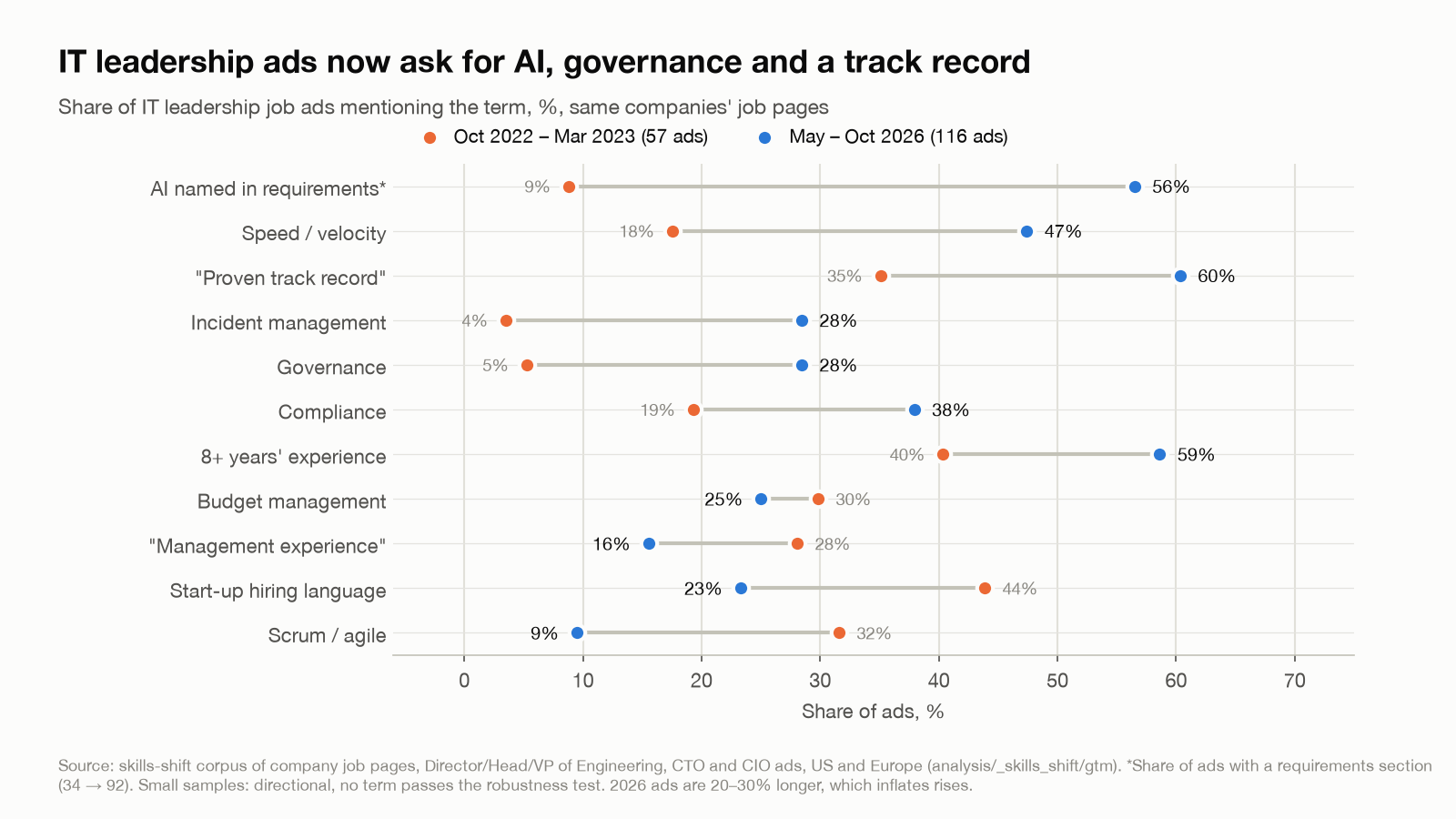
Among ads with a requirements section, the share that names AI there went from 9 % to 56 %. Governance went from 5 % to 28 % of ads, incident management from 4 % to 28 %, compliance from 19 % to 38 % and "proven track record" from 35 % to 60 %. Requests for eight or more years of experience went from 40 % to 59 %. Two terms fell: scrum and agile from 32 % to 9 %, and "management experience" from 28 % to 16 % [job-page study, 2026]. Today's ad wants someone who has done the job before, can run an incident and can answer an auditor. It says much less about managing people.
Europe also has a regulatory calendar. The EU AI Act came into force in August 2024. Its bans and the duty to give staff AI literacy applied from February 2025, and the rules for general-purpose models from August 2025. The high-risk obligations were due in August 2026 until the Digital Omnibus moved them to December 2027 [Gibson Dunn, 2026]. NIS2 had to be in national law by October 2024, and in November 2024 the Commission wrote to 23 member states that had missed the deadline [European Commission, 2024]. DORA has applied to financial firms since January 2025 [Cloud Security Alliance, 2025]. In ENISA's 2025 survey, 70 % of organisations named NIS2 as the main driver of their security spending [HaystackID, 2025].
Judged on AI value that few can show
Gartner's October 2026 survey of 2,002 CIOs shows how leaders are now judged. Only 13 % say their organisation has had significant or transformational value from AI. Fifty-eight per cent face more pressure to show cost savings from it, 51 % expect it to raise the total cost of their technology, and 40 % still expect to add IT staff in 2027, mostly in security and data [Gartner, 2026]. In May 2025, 72 % of CIOs had said their organisations broke even or lost money on AI [Gartner, 2025]. Nash Squared found that 67 % of technology leaders had no measurable return from AI pilots, and that 51 % reported a shortage of AI skills, up from 28 % [Nash Squared, 2025].
The CIOs who do best in Gartner's data are the ones with clear rules for stopping work. Only 31 % have rules for stopping a pilot, 17 % for switching off AI in production that does not pay, and 4 % have a plan to redesign roles around people working with AI agents [Gartner, 2026].
Pay did not keep up with headcount. The US median for IT managers rose from $164,070 to $175,140 between 2022 and 2025, which is 3.0 % less in real terms after 10.1 % inflation [BLS OEWS, 2025; FRED, 2026]. In Hays' UK guides, leadership salaries rose 6.7 % in cash between the 2023 and 2026 editions, which is a 6.2 % fall after inflation [Hays UK, 2023 and 2026].
When I sold storage and backup into enterprise IT, a CIO meeting was about uptime, the latest audit finding and the renewal. In 2026 it starts with the board's AI question and ends with a regulatory deadline, and fewer managers sit in between to handle the detail.
What this means if you are an IT leader
- Agree a stopping rule with the CFO before the project starts, and put the number at which you switch off a pilot, or a live AI tool, in writing. Only 31 % of CIOs have such rules for pilots and 17 % for AI in production, and Gartner's best performers are more than twice as likely to have them.
- Own the European compliance calendar yourself: AI literacy training now, NIS2 and DORA evidence for your board, and the AI Act's high-risk duties by December 2027. A Chief AI Officer can run the programmes, but the accountability stays with you, and leadership ads now mention governance about five times as often as in 2022-23.
- Keep your managers of small teams. They are where your next CIO comes from. Gartner expects firms that cut junior roles for AI to hollow out their engineering pipeline by 2028, and Meta has already started to undo its 50-to-1 spans.
When fewer managers sit between the CIO and the racks, routine hardware checks have to report themselves instead of waiting for someone to chase them, which is the job of out-of-band hardware monitoring.
Sources
- US Bureau of Labor Statistics, Occupational Employment and Wage Statistics, national files May 2022 to May 2025 (SOC 11-3021, 11-2021, 11-2022, 15-1212, 15-1231, 15-1232, 15-1241, 15-1242, 15-1244, 15-1252, 15-1253, 15-1211). https://www.bls.gov/oes/special-requests/oesm25nat.zip (ai-era-it-jobs study data)
- US Bureau of Labor Statistics, Employment Projections, occupation tables, current ten-year edition. https://www.bls.gov/emp/
- US Bureau of Labor Statistics, CPI-U (CPIAUCSL), via FRED, May 2022 to May 2025. https://fred.stlouisfed.org/series/CPIAUCSL
- ITJobsWatch, UK permanent vacancy and salary trends for CIO, CTO, IT Director, Head of IT, Head of Engineering and Head of AI, six months to 20 October 2024, 2025 and 2026, retrieved 20 October 2026. https://www.itjobswatch.co.uk/jobs/uk/head%20of%20ai.do ; https://www.itjobswatch.co.uk/jobs/uk/cio.do ; https://www.itjobswatch.co.uk/jobs/uk/chief%20technology%20officer.do ; https://www.itjobswatch.co.uk/jobs/uk/head%20of%20it.do
- US Office of Management and Budget, Memorandum M-24-10, "Advancing Governance, Innovation, and Risk Management for Agency Use of Artificial Intelligence", 28 March 2024. https://www.whitehouse.gov/wp-content/uploads/2024/03/M-24-10-Advancing-Governance-Innovation-and-Risk-Management-for-Agency-Use-of-Artificial-Intelligence.pdf
- Randy Bean / DataIQ, "2025 AI and Data Leadership Executive Benchmark Survey", 10 January 2025. https://www.dataiq.global/articles/2025-ai-and-data-leadership ; 2026 edition summary: https://babl.ai/survey-finds-corporate-ai-adoption-moves-from-experimentation-to-deployment-at-scale/
- Heidrick & Struggles, "2024 Global Chief Information Security Officer (CISO) Organization and Compensation Survey", 2024. https://www.heidrick.com/en/insights/cybersecurity/2024-global-chief-information-security-officer-organization-and-compensation-survey
- Heidrick & Struggles, "2025 Global Chief Information Security Officer Compensation Survey", 2025. https://www.heidrick.com/en/insights/cybersecurity/2025-global-chief-information-security-officer-compensation-survey
- Eurostat, "Artificial intelligence by size class of enterprise" (isoc_eb_ai), 2021 to 2025, dataset updated 15 June 2026. https://ec.europa.eu/eurostat/databrowser/view/isoc_eb_ai/
- Osborne Clarke, "Poland's amendment to the National Cybersecurity System Act has been signed by the President", 2026. https://www.osborneclarke.com/insights/polands-amendment-national-cybersecurity-system-act-has-been-signed-president
- Sedlak & Sedlak, Ogólnopolskie Badanie Wynagrodzeń, "Ile zarabia dyrektor działu IT" (n=305), updated January 2026. https://wynagrodzenia.pl/moja-placa/ile-zarabia-dyrektor-dzialu-it
- GeekWire, "Amazon corporate headcount drops year over year as tech giant aims for efficiency", September 2024. https://www.geekwire.com/2024/amazon-corporate-headcount-drops-year-over-year-as-tech-giant-aims-for-efficiency/
- TechRepublic, "Microsoft Lays Off 3% of Workers, Focuses on a Leaner Management Tier", 13 May 2025. https://www.techrepublic.com/article/news-microsoft-layoffs-may-25/
- NBC News / CNBC, "Google has eliminated 35% of managers overseeing small teams in past year, exec says", 27 August 2025. https://www.nbcnews.com/business/business-news/google-eliminated-35-percent-managers-overseeing-small-teams-exec-says-rcna227486
- CIO Dive, "4 ways AI could impact employees, workflows: Gartner", 22 October 2024. https://www.ciodive.com/news/Gartner-symposium-top-predictions-CIOs-AI-impact/730659/
- The Daily Brief (Rajesh Beri), "Meta's applied-AI 50-to-1 span of control reversal", 13 September 2026. https://www.beri.net/article/meta-applied-ai-50-to-1-span-of-control-reversal-manager-work-ai-did-not-absorb
- Mustard Seed Solutions, job-page study of IT leadership ads, October 2022 to March 2023 (57) vs May to October 2026 (116), company job pages on Greenhouse, Lever and Ashby boards via Common Crawl, the Wayback Machine and live boards. ai-era-it-jobs study data.
- Gibson Dunn, "EU AI Act Omnibus Agreement: Postponed High-Risk Deadlines and Other Key Changes", 27 May 2026. https://www.gibsondunn.com/eu-ai-act-omnibus-agreement-postponed-high-risk-deadlines-and-other-key-changes/
- European Commission, "Commission calls on 23 Member States to fully transpose the NIS2 Directive", 28 November 2024. https://digital-strategy.ec.europa.eu/en/news/commission-calls-23-member-states-fully-transpose-nis2-directive
- Cloud Security Alliance, "An Update on European Compliance: NIS2, CRA, DORA", 2025. https://cloudsecurityalliance.org/articles/an-update-on-european-compliance-nis2-cra-dora
- HaystackID, summary of the ENISA NIS Investments Report 2025 (1,080 organisations), December 2025. https://newsline.haystackid.com/enisa-2025-nis-investments-report-technology-prioritized-as-cyber-talent-pools-contract/
- Gartner, "Gartner Survey Finds Only 13% of CIOs Say Their Enterprise Has Realized Significant or Transformational Value from AI" (2,002 CIOs, May to July 2026), 19 October 2026. https://www.gartner.com/en/newsroom/press-releases/2026-10-19-gartner-survey-finds-only-13-percent-of-cios-say-their-enterprise-has-realized-significant-or-transformational-value-from-ai
- Gartner, "Gartner Survey Finds All IT Work Will Involve AI by 2030", 20 October 2025. https://www.gartner.com/en/newsroom/press-releases/2025-10-20-gartner-survey-finds-all-it-work-will-involve-ai-by-2030-organizations-must-navigate-ai-readiness-and-human-readiness-to-find-capture-and-sustain-value
- Gartner, "Gartner Predicts 60% of Organizations Will Adopt Smaller Software Engineering Teams by 2029", 7 July 2026. https://www.gartner.com/en/newsroom/press-releases/2026-07-07-gartner-predicts-60-percent-of-organizations-will-adopt-smaller-software-engineering-teams-by-2029
- Nash Squared / Harvey Nash, "AI creates the world's biggest tech skills shortage in over 15 years" (Digital Leadership Report 2025), June 2025. https://www.harveynashusa.com/posts/ai-creates-the-world-s-biggest-tech-skills-shortage-in-over-15-years-finds-nash-squared-harvey-nash-report
- Hays UK, technology salary guides 2023 and 2026 (leadership rows, n=157; real change computed with UK CPI in the synthesis report). https://www.hays.co.uk/documents/d/global/hays-technology-salary-guide-2023 ; https://www.hays.co.uk/documents/d/global/hays-pdf-tech-uksg26 (derived: ai-era-it-jobs study data)
See hardware, power and cooling health from outside the operating system. Request an online trial and explore how Sensaka brings hardware, operations and business services into one platform.
Request an Online Trial →Sensaka AI & GPU Infrastructure Observability
Full-stack thermal, liquid cooling, and BMC hardware monitoring for high-density NVIDIA H100/B200 GPU racks and AI clusters.
Related articles & analysis