
The "AI layoff": 4,247 cuts in 2023, 120,000 in nine months of 2026
US employers now name AI in one announced job cut in five. Most of the memos behind that number describe hiring that will not happen. Few describe people replaced by software.
Part of the AI-era IT jobs series. Start with CIO and IT manager jobs grew 26 %. The managers under them got cut..
In 2023 US employers named artificial intelligence as the reason for 4,247 announced job cuts. Between January and September 2026 they named it for 120,136, which is 21 % of all cuts announced in that period [Challenger, 2026]. The 2023 figure was 0.6 % of all announced cuts, and by October 2025 AI was the second most cited reason of the month. The count records the reason an employer gives and nothing more. Most of the memos behind it describe jobs that will not be filled. A few describe people a tool replaced, and several of those were later walked back.
From a footnote to one cut in five
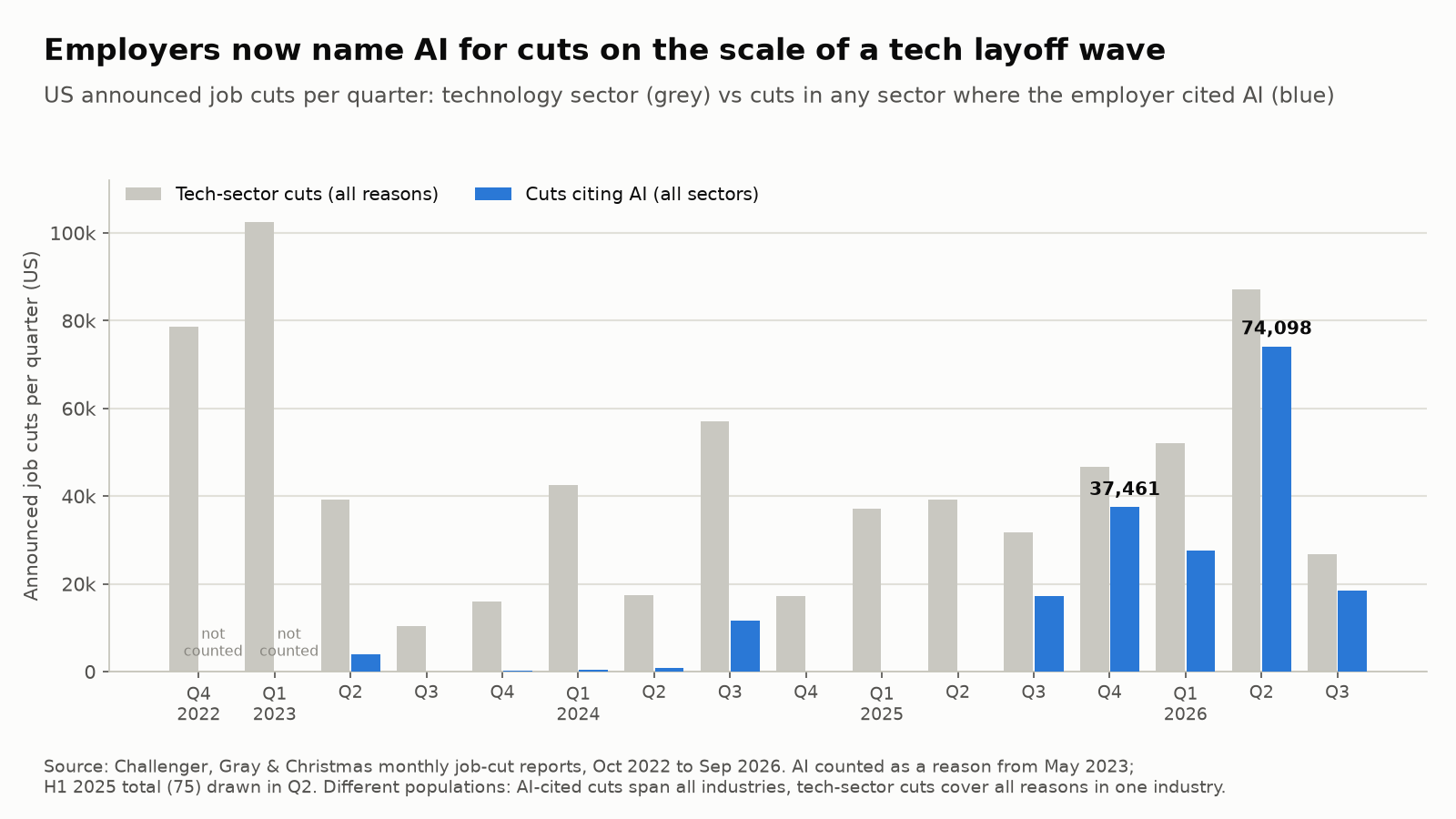
Challenger, Gray & Christmas started counting AI as a separate reason in May 2023, with 3,900 cuts that month [Challenger, 2023]. For the next two years it stayed small: 12,742 in January to September 2024, and only 75 in the first half of 2025 [Challenger, 2024 and 2025]. From the summer of 2025 it rose fast. October 2025 alone brought 31,039, and the year closed at 54,836, or 4.5 % of 1.21 million announced cuts [Challenger, 2025]. The second quarter of 2026 brought 74,098 AI-cited cuts, with 38,579 in May, the highest month in the series [Challenger, 2026].
For scale, Challenger counted 168,032 cuts at technology companies in 2023, 154,445 in 2025 and 165,925 in the first nine months of 2026 [Challenger, 2023–2026]. The AI-cited figure covers all industries, so the two are not nested. Still, in the second quarter of 2026 the AI-cited count, 74,098, came close to the tech sector's 87,106.
Read the chart with two cautions. Challenger records the reason the employer gives, and "AI" costs nothing to say in 2026 while "weak demand" costs a share price. And these are announcements, not jobs lost on a given date.
What the memos actually say
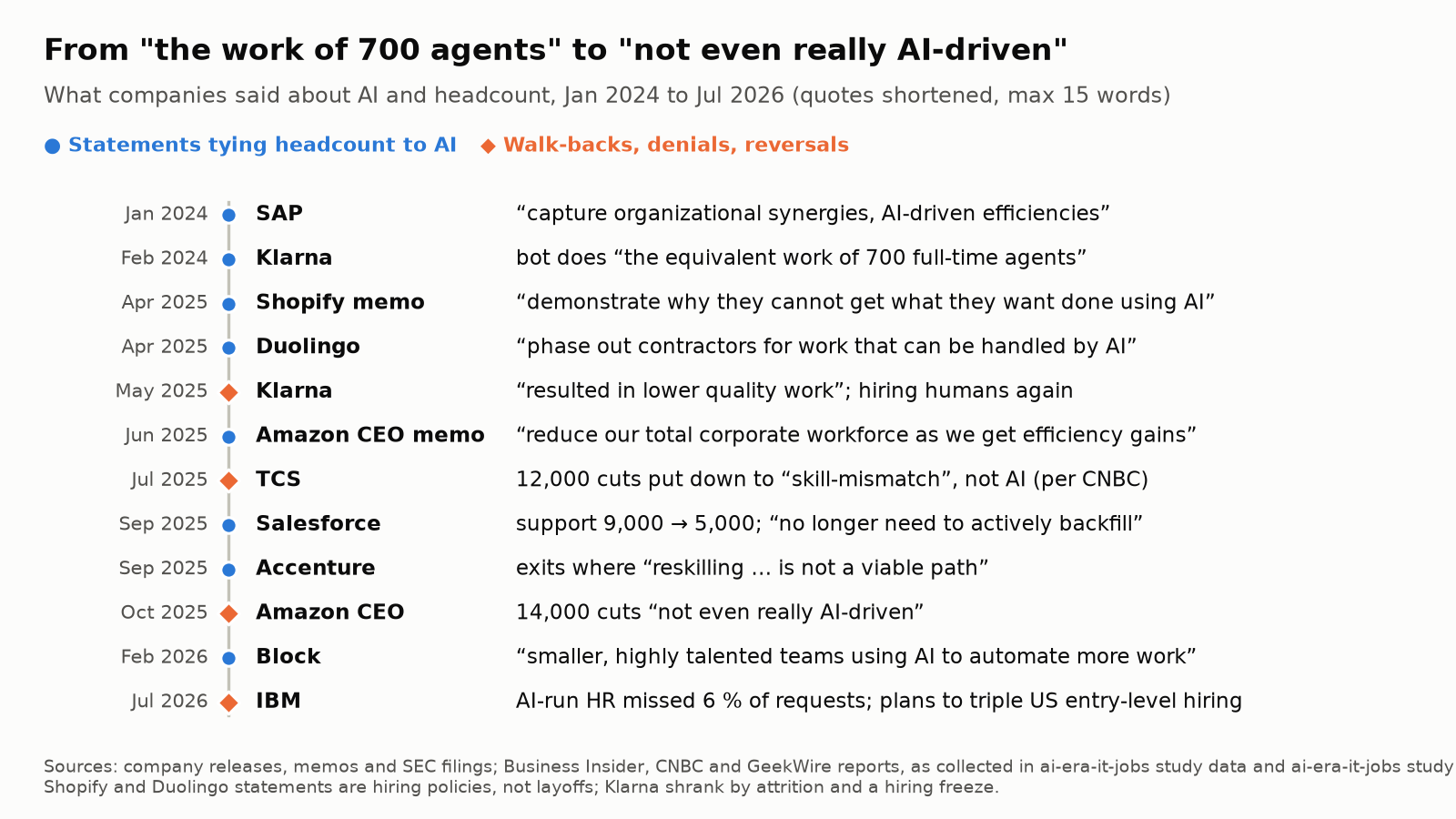
The famous 2025 memos were mostly about hiring. Shopify told teams to show why AI could not do the work before asking for headcount [Shopify, 2025]. Duolingo said it would phase out contractors for work AI can handle [Fortune, 2025]. Amazon's CEO wrote in June 2025 that he expected the corporate workforce to shrink as efficiency gains arrived [Amazon, 2025]. None of the three was a layoff when it was written. They changed who has to prove what. A manager used to have to justify a requisition with workload. After these memos the manager has to justify it against a tool, whether or not the tool exists yet.
Where the cuts were real, they landed on support. Salesforce took its support organisation from about 9,000 to about 5,000 people and said it "no longer" needed to backfill support engineer roles [Business Insider, 2025]. Klarna never announced a layoff. It froze hiring and let attrition work, going from about 5,527 full-time employees in 2022 to 3,422 in 2024 and 2,831 in 2025, by its own filings [Klarna F-1 and 20-F, 2025–2026]. Accenture's version was a $865 million programme, including severance, to exit people for whom, in the CEO's words, reskilling "is not a viable path" [Accenture, 2025].
The walk-backs came fast. Klarna's CEO told interviewers in May 2025 that leaning fully on AI support had produced lower-quality work and that the company was hiring humans again [Entrepreneur, 2025]. TCS said its 12,000 cuts came from a skills mismatch, not AI [CNBC, 2025]. After cutting 14,000 corporate roles in October 2025, Amazon's CEO said the cut was "not even really AI-driven" [GeekWire, 2025]. IBM, which in 2023 paused back-office hiring it expected AI to do, announced in 2026 that it would triple US entry-level hiring after its AI-run HR could not handle 6 % of requests [CNBC, 2026].
Stated, implied, denied
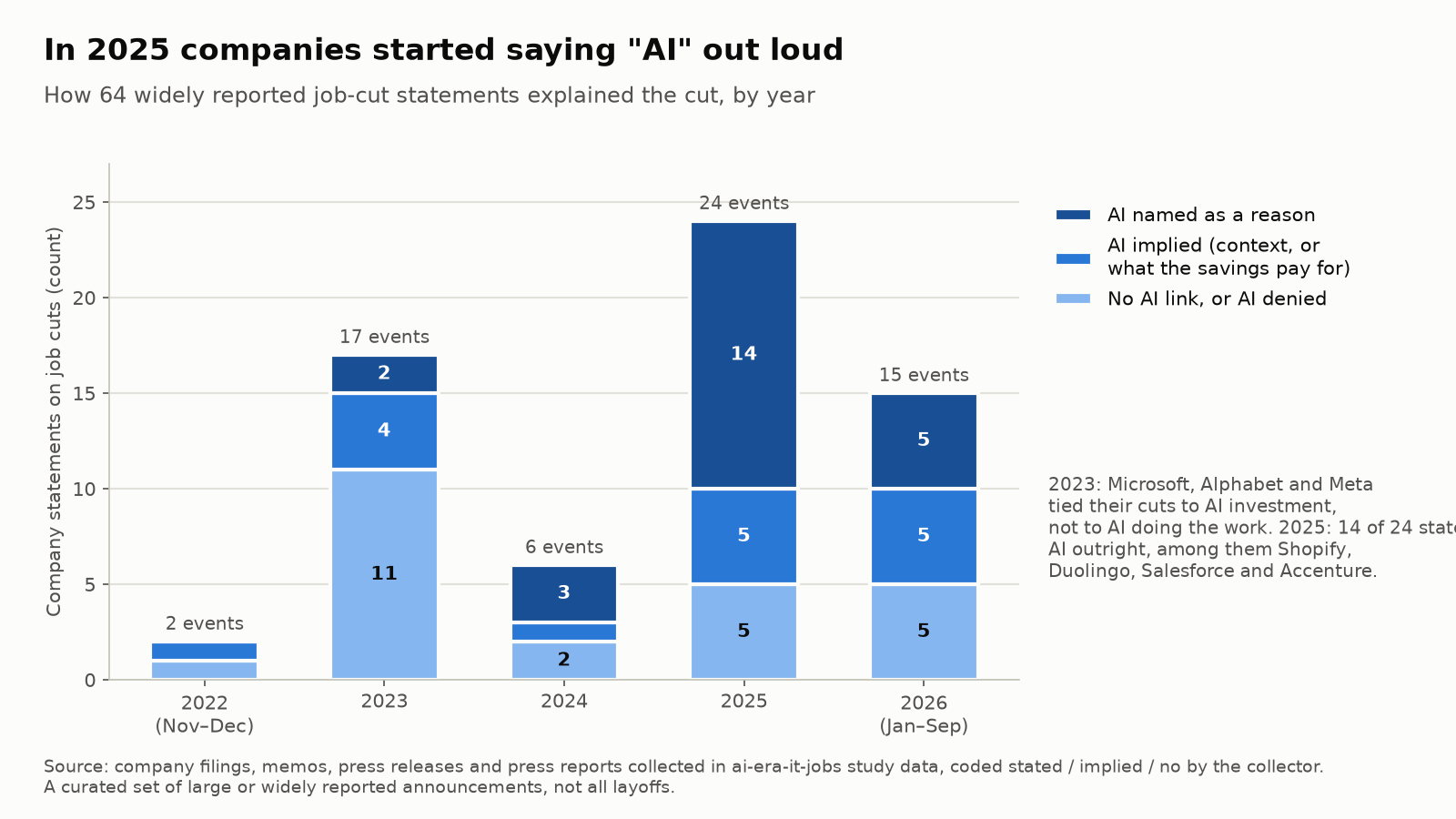
Our collectors coded 64 large or widely reported cut announcements from November 2022 to September 2026. In 2023 only 2 of 17 named AI. Microsoft, Alphabet and Meta tied their cuts to the cost of investing in AI rather than to AI doing the work. In 2025, 14 of 24 statements named AI outright [ai-era-it-jobs layoff tracker, 2026]. Count people instead of statements and it flips. Statements that name AI cover 23,805 jobs, those that imply it 76,300, and those with no AI link 111,728 [ai-era-it-jobs layoff tracker, 2026], so the biggest cuts mostly still don't mention AI.
The registers that count people do not record reasons at all. WARN notices from technology employers in California, Washington and Texas covered 15,056 workers in 2025 and 20,262 so far in 2026. The layoffs.fyi tracker logged 122,606 tech layoffs in 2025 and 131,937 by mid-October 2026 [ai-era-it-jobs layoff tracker, 2026]. Both are higher in 2026 than in 2025, but nowhere near the doubling in AI-cited cuts. My read: a good part of the AI number is a new label on cost-cutting that would have happened anyway.
The service desk, where the replacement story is strongest, says the same in surveys. Only 20 % of customer-service leaders told Gartner they had cut agent staffing because of AI. In the same survey, published in April 2026, 31 % had layoffs done or planned through early 2027, while 63 % were shrinking frontline teams through attrition [Gartner, 2025 and 2026]. Gartner expects half of the organisations that planned big AI-driven service cuts to drop those plans by 2027 [Gartner, 2025].
Europe: the AI layoff is a hiring freeze
European companies are a small part of the tracker data: 23 of 333 events and 6,406 of 122,606 people in 2025 were in the EU, and 6,309 of 131,937 in 2026 [ai-era-it-jobs layoff tracker, 2026]. We have no European equivalent of the WARN filings, so the visible European cases are company statements. SAP's 2024 programme cited "AI-driven efficiencies" for 8,000 positions, most handled through voluntary leave and reskilling, with headcount expected flat [SAP, 2024]. Capgemini booked about €700 million of restructuring over two years for a technology shift "primarily driven" by AI, and had 2,400 fewer onshore and 3,400 fewer offshore staff by mid-2026 [Capgemini, 2026]. Siemens, Ericsson and Zalando cut without mentioning AI.
The European pattern shows up where graduates enter. KPMG UK cut its graduate intake to 942, down 29 % [Accountancy Age, 2025], and PwC UK went from 1,500 entry-level hires to 1,300 while its UK boss said AI was reshaping roles [Consultancy.uk, 2025]. In Poland, Kraków's outsourcing centres had announced 4,195 planned layoffs by the end of October 2025 [Outsource Accelerator, 2025], with no AI reason attached in our files.
What this means if you work in IT
- Read your employer's statements the way an analyst would. "AI-driven efficiencies" in a results release is a budget decision. A memo that makes teams prove AI can't do the work is a hiring freeze. Neither tells you a tool can do your job, so ask which of your tasks the tool covers today, with numbers.
- If you sit in support, operations or a shared-service centre, the pressure usually arrives as attrition nobody backfills. Watch the open headcount on your team, and move toward work that is harder to hand to a bot, such as escalations and the automation itself.
- If you manage people, keep a record of what the tools actually resolve and what they get wrong. Klarna, IBM and Commonwealth Bank all reversed AI-based cuts or hiring freezes [Entrepreneur, 2025; CNBC, 2026; People Matters, 2025]. When your company declares the AI layoff, the manager with measured numbers is the one who can stop the cut that won't hold.
Hiring that will not happen still leaves the same racks to run, so the routine checks have to move into tooling such as hardware monitoring.
See hardware, power and cooling health from outside the operating system. Request an online trial and explore how Sensaka brings hardware, operations and business services into one platform.
Request an Online Trial →Sensaka AI & GPU Infrastructure Observability
Full-stack thermal, liquid cooling, and BMC hardware monitoring for high-density NVIDIA H100/B200 GPU racks and AI clusters.
Related articles & analysis