
What's next for CIOs and IT managers, 2027–2029
US IT manager jobs are forecast to keep growing, but more slowly. In Europe the growing seats are Head of AI, security leadership and governance-heavy roles. Five openings, the skills to add and drop, and a 90-day plan.
Part of the AI-era IT jobs series. Start with CIO and IT manager jobs grew 26 %. The managers under them got cut..
The US employed 670,570 computer and information systems managers in May 2025, 26 % more than in 2022 [BLS OEWS, 2025]. The synthesis report behind this series forecasts at least 690,000 by May 2027, with medium-high confidence, and 690,000 to 760,000 by May 2029 [synthesis report, 2026]. That is still growth, but far below the 910,000 that the 2022-25 pace would give. In the UK the fastest-growing leadership title is Head of AI, and the CIO title barely moved. This post carries the trend lines to 2029 and turns them into five openings, a list of skills to add and drop, and a 90-day plan.
Where the job stands in October 2026
Three measured numbers set the starting point. First, UK permanent adverts for "Head of AI" went from 20 in the six months to October 2024 to 151 in the same period of 2026, at a £100,000 median, the same as a CTO. CIO adverts went from 13 to 14 [ITJobsWatch, 2026]. Second, US IT manager employment grew 11.1 % between 2022 and 2023 but only 3.8 % between 2024 and 2025 [BLS OEWS, 2025]. Third, pay did not keep up. The US median rose from $164,070 to $175,140 between 2022 and 2025, a 3.0 % fall after inflation, and leadership salaries in Hays' UK guides fell 6.2 % in real terms between the 2023 and 2026 editions [BLS OEWS, 2025; Hays UK, 2023 and 2026].
The pressure on the role is reported rather than measured. Only 13 % of CIOs told Gartner in 2026 that AI had brought significant or transformational value, and 58 % face more pressure to show cost savings from it [Gartner, 2026].
The trend lines to 2029
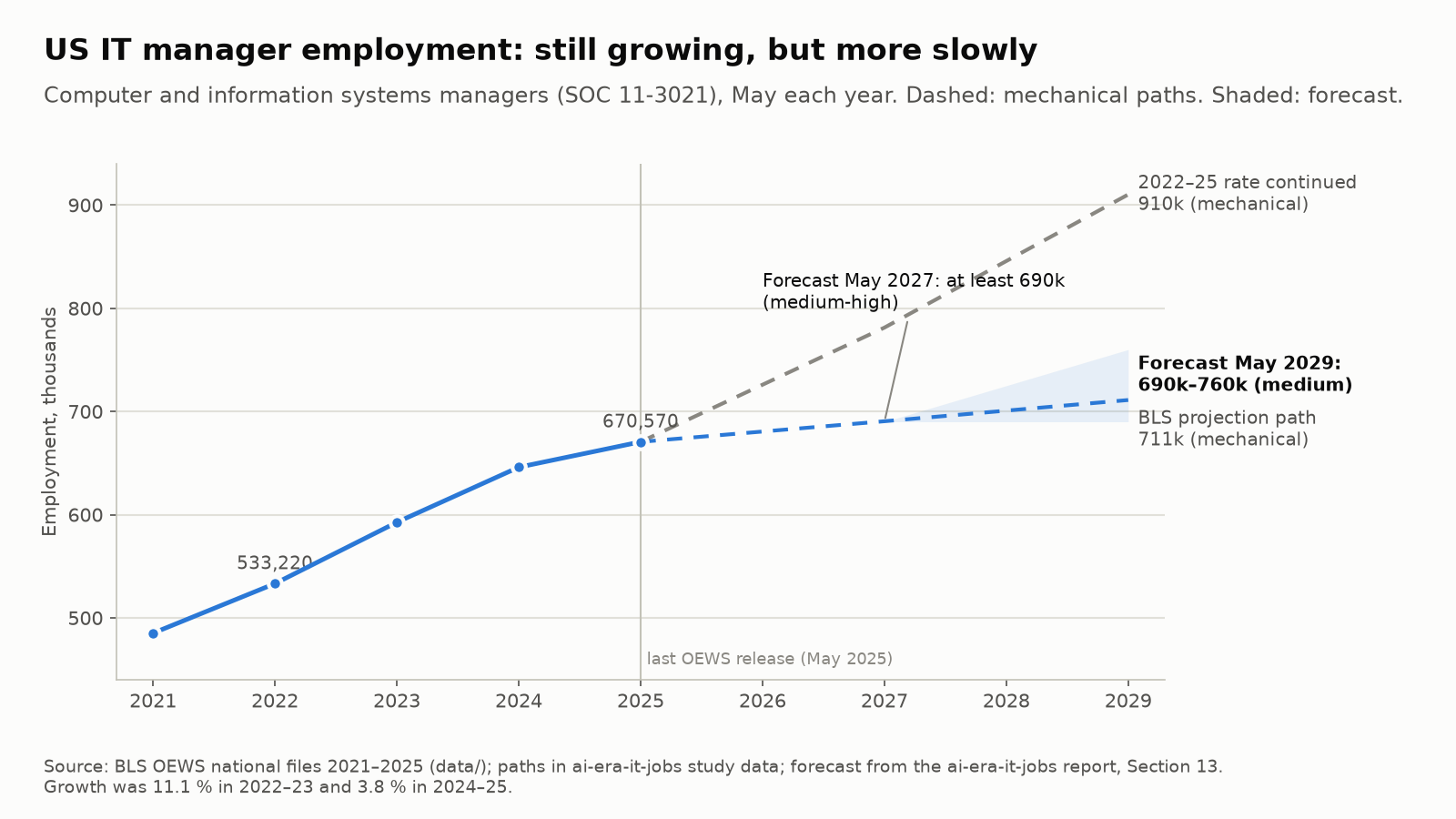
The chart shows two mechanical paths from May 2025. Carrying the 2022-25 growth rate forward gives 910,000 by 2029. Spreading the BLS ten-year projection of 15.8 % evenly gives 711,000. The report's forecast sits near the BLS path, because growth is already slowing [synthesis report, 2026]. These are the leadership calls from Section 13 of that report, with their confidence:
- US IT manager employment at or above 690,000 in May 2027 (medium-high). Watch for the May 2026 count at or above 680,000.
- 690,000 to 760,000 in May 2029 (medium).
- UK Head of AI adverts at least five times CIO adverts in the six months to October 2027 (medium).
- Fewer than 25 % of CIOs reporting significant AI value in Gartner's October 2027 survey (medium).
- More than 35 % of CISOs still reporting to the CEO in 2029, up from 14 % in 2024 and 42 % in 2025 (medium).
- Fewer than half of Fortune 1000 firms keeping a separate Chief AI Officer in 2029, with the role merging into data, digital or CIO titles (low). It was 33.1 % in 2025 and 38.5 % in 2026.
Two cross-cutting calls matter here as well. Real pay in the large IT occupations stays within 3 % of its 2025 level through 2028 (medium). The AI Act's high-risk duties, NIS2 and DORA create governance and security roles in 2027-28 (medium-low) [synthesis report, 2026].
Five openings for the next three years
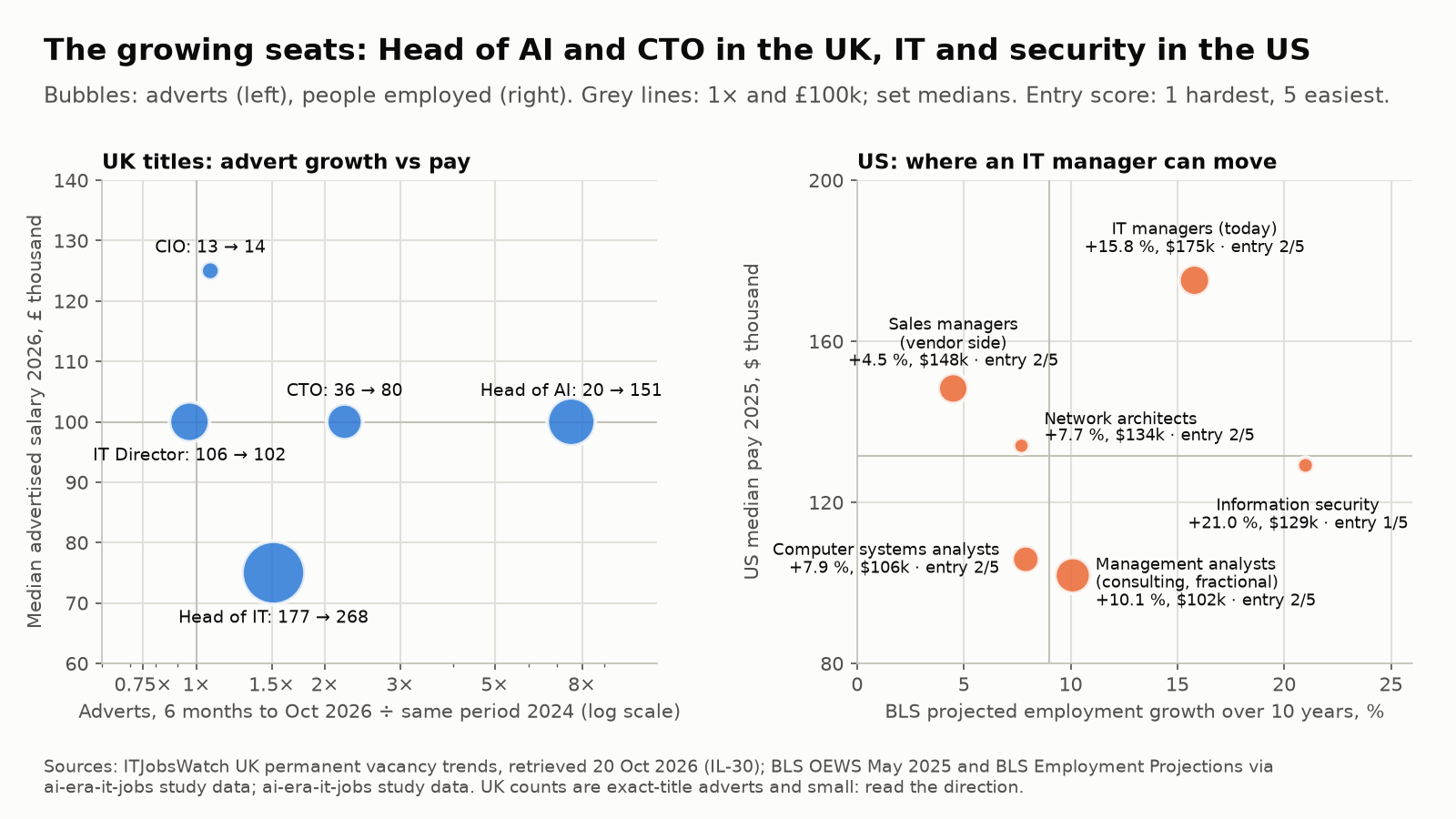
- AI leadership, under whatever name survives. Head of AI adverts grew 7.5 times in two years and pay the same as a CTO. The report expects the separate title to merge into data, digital or CIO roles by 2029, so aim for the combined seat: Chief Data and AI Officer, or a CIO who owns the AI budget.
- Security leadership with a line to the CEO. The share of CISOs reporting to the CEO rose from 14 % to 42 % in a year [Heidrick & Struggles, 2024 and 2025], and the BLS projects 21 % growth for information security analysts. Of the US occupations on the map, only information security has a higher projected growth rate than IT management, so for an IT leader with security depth this is the move.
- Regulated European employers. In leadership ads, governance went from 5 % to 28 % and compliance from 19 % to 38 %. Mentions of financial services went from 9 % to 32 % [job-page study, 2026]. Banks under DORA and NIS2 entities need leaders who can run an audit as well as a platform, and the AI Act's high-risk duties start in December 2027.
- Fractional and interim leadership. Lightcast counted 677 US postings for fractional roles in 2025 and about 1,000 in January to July 2026 [Lightcast, 2026]. The report forecasts this route will grow faster than firm employment, with medium-low confidence. It pays less: management analysts, the nearest BLS occupation, had a $101,860 median in 2025 and lost 2.9 % in real terms.
- Poland and CEE, on site or hybrid. Only 8.4 % of Polish firms used AI in 2025, against 20.0 % across the EU [Eurostat, 2026], so most Polish employers need a first production deployment and NIS2 compliance under the national law in force since April 2026. A Polish IT department director earns a median 26,350 PLN a month [Sedlak & Sedlak, 2026]. Expect the office: remote mentions in leadership ads fell from 42 % to 37 % while hybrid rose from 14 % to 34 % [job-page study, 2026].
Skills to add in the next 12 months, and what to stop leading with
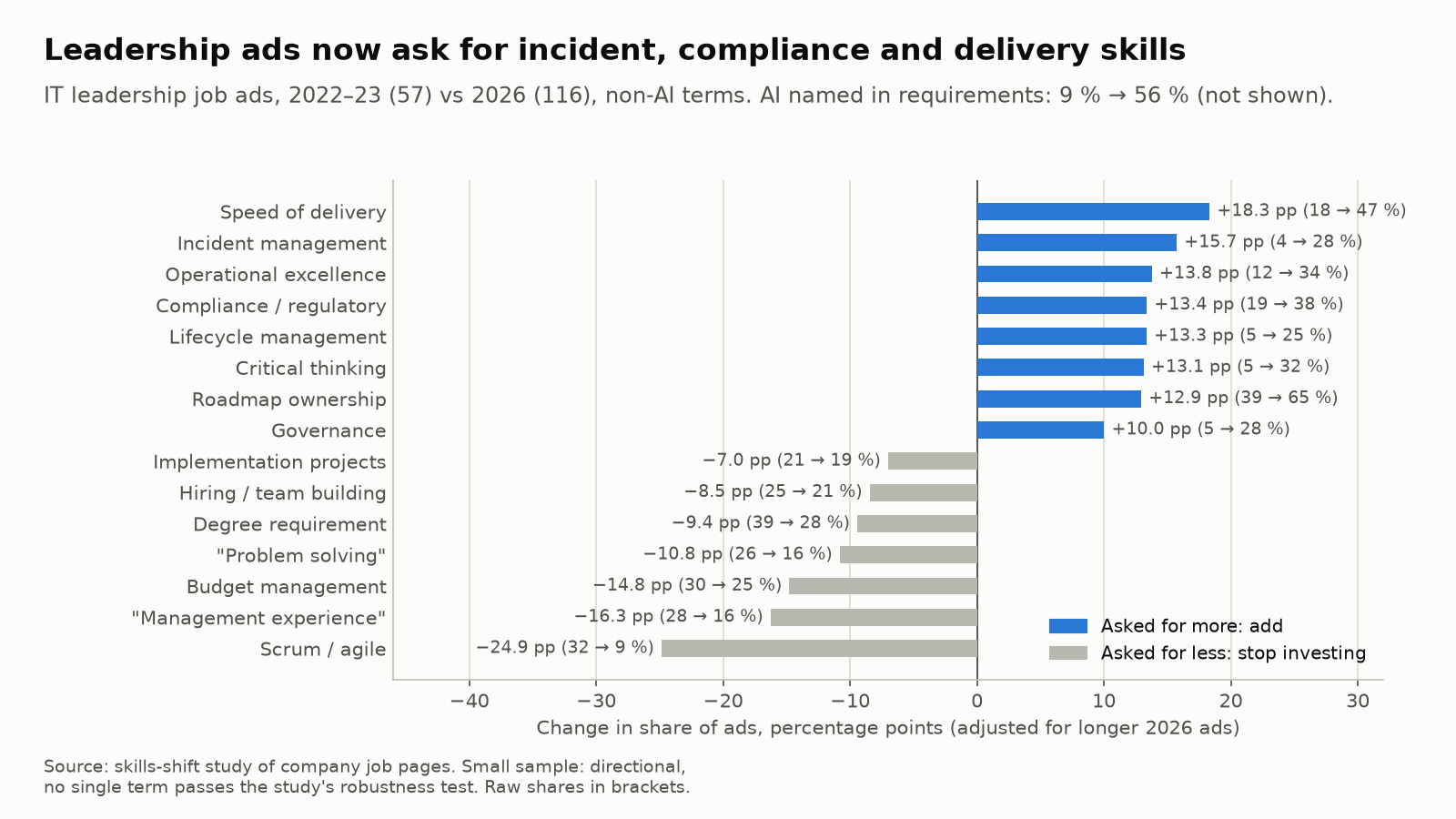
The non-AI skills that rose most in leadership ads are operational. Incident management went from 4 % to 28 % of ads, operational excellence from 12 % to 34 %, and speed of delivery from 18 % to 47 %. Roadmap ownership rose from 39 % to 65 %, compliance from 19 % to 38 % and governance from 5 % to 28 % [job-page study, 2026]. "Proven track record" went from 35 % to 60 %, so these skills count only with results attached.
On the AI side, ads naming AI in their requirements section went from 9 % to 56 % [job-page study, 2026]. The specific AI skill to add is governance. AI management frameworks (ISO 42001, the NIST AI Risk Management Framework, the EU AI Act) appeared in none of the 2022-23 security ads and in 5.4 % of 2026 ones. In ISACA's 2025 survey, 47 % of security professionals had helped build AI governance, up from 35 % [ISACA, 2025]. Add the habit Gartner ties to its best performers as well: only 31 % of CIOs have rules for stopping a pilot, 17 % for switching off AI that does not pay, and 4 % have a plan to redesign roles around people working with AI agents [Gartner, 2026].
Stop leading with what the ads stopped asking for. Scrum and agile fell from 32 % to 9 % of leadership ads and "management experience" from 28 % to 16 %. Degree requirements fell from 39 % to 28 % [job-page study, 2026]. People management still appears in more than half of the ads, so keep it, but it does not set you apart. Another certificate or degree buys less than a documented incident you ran or a control you passed an audit on. All of this comes from 57 and 116 ads, so it shows the direction, not the size.
Three numbers to watch in 2027
- The May 2026 OEWS count, published in spring 2027. At or above 680,000 IT managers supports the 2027 forecast. Growth below 3 % supports the slower 2029 range.
- ITJobsWatch, six months to April 2027. If Head of AI adverts stay at five or more times CIO adverts, the AI seat is still the growing one.
- Mid-2027 AI-value surveys from McKinsey and Nash Squared, then Gartner in October. A share of CIOs reporting significant value still under 25 % means boards keep judging IT leaders on stopping rules and cost.
A 90-day plan
From my years selling into enterprise IT, the leaders who moved up were the ones who could show a number. In 2026 that number is a pilot switched off, an audit passed or an incident closed.
- Days 1 to 30. List every AI pilot and tool you pay for. Write a stopping rule for each, agree it with the CFO, and switch off the first one that fails it.
- Days 31 to 60. Build your regulatory map: which of NIS2, DORA and the AI Act apply, who owns each control, and when your next audit evidence is due. Run one incident exercise and write up what broke.
- Days 61 to 90. Rewrite your CV and LinkedIn profile around results: incidents handled, controls passed, delivery time cut, tools switched off. Then pick one seat from the opportunity map, either Head of AI, security leadership, a regulated European employer or a fractional mandate, and talk to three people who already hold it.
Leaders judged on cost and stopping rules need a plain record of what their infrastructure is and what it depends on; for the operations side, that is the record Sensaka's CMDB & ITSM module keeps.
Sources
- US Bureau of Labor Statistics, Occupational Employment and Wage Statistics, national files May 2021 to May 2025 (SOC 11-3021 and the other occupations on the map). https://www.bls.gov/oes/special-requests/oesm25nat.zip (ai-era-it-jobs study data)
- US Bureau of Labor Statistics, Employment Projections, occupation tables, current ten-year edition. https://www.bls.gov/emp/ ; mechanical paths computed in the ai-era-it-jobs study data.
- US Bureau of Labor Statistics, CPI-U (CPIAUCSL), via FRED. https://fred.stlouisfed.org/series/CPIAUCSL
- Mustard Seed Solutions, "How AI changed the IT job market, 2022 → 2026, and where it goes 2027–2029", ai-era-it-jobs report, 21 October 2026, Sections 12 to 14 (forecasts, scorecard). ai-era-it-jobs study data.
- ITJobsWatch, UK permanent vacancy and salary trends for Head of AI, CTO, CIO, IT Director and Head of IT, six months to 20 October 2024 and 2026, retrieved 20 October 2026. https://www.itjobswatch.co.uk/jobs/uk/head%20of%20ai.do ; https://www.itjobswatch.co.uk/jobs/uk/cio.do
- Hays UK, technology salary guides 2023 and 2026 (leadership rows, n=157; real change in the ai-era-it-jobs study data). https://www.hays.co.uk/documents/d/global/hays-technology-salary-guide-2023 ; https://www.hays.co.uk/documents/d/global/hays-pdf-tech-uksg26
- Gartner, "Gartner Survey Finds Only 13% of CIOs Say Their Enterprise Has Realized Significant or Transformational Value from AI", 19 October 2026. https://www.gartner.com/en/newsroom/press-releases/2026-10-19-gartner-survey-finds-only-13-percent-of-cios-say-their-enterprise-has-realized-significant-or-transformational-value-from-ai
- Heidrick & Struggles, 2024 and 2025 Global CISO surveys. https://www.heidrick.com/en/insights/cybersecurity/2024-global-chief-information-security-officer-organization-and-compensation-survey ; https://www.heidrick.com/en/insights/cybersecurity/2025-global-chief-information-security-officer-compensation-survey
- Randy Bean / DataIQ, AI and Data Leadership Executive Benchmark Survey, 2025 and 2026 editions. https://www.dataiq.global/articles/2025-ai-and-data-leadership ; https://babl.ai/survey-finds-corporate-ai-adoption-moves-from-experimentation-to-deployment-at-scale/
- Mustard Seed Solutions, skills-shift study of IT leadership job ads, October 2022 to March 2023 (57) vs May to October 2026 (116), company job pages on Greenhouse, Lever and Ashby boards. ai-era-it-jobs study data; AI-governance framework counts in the ai-era-it-jobs study data (security ads from the ai-era-it-jobs study data).
- ISACA, State of Cybersecurity 2025, press release, 29 September 2025. https://www.isaca.org/about-us/newsroom/press-releases/2025/state-of-cybersecurity-2025-global-press-release
- Lightcast, "The rise of fractional leadership", 20 August 2026. https://lightcast.io/blog/rise-of-fractional-leadership
- Eurostat, enterprises using AI (isoc_eb_ai), 2025, updated 15 June 2026. https://ec.europa.eu/eurostat/databrowser/view/isoc_eb_ai/
- Sedlak & Sedlak, Ogólnopolskie Badanie Wynagrodzeń, "Ile zarabia dyrektor działu IT" (n=305), updated January 2026. https://wynagrodzenia.pl/moja-placa/ile-zarabia-dyrektor-dzialu-it
- Dudkowiak and KPMG Poland on Poland's NIS2 law (KSC amendment in force 3 April 2026). https://www.dudkowiak.com/regulatory-in-poland/nis-2-in-poland/ ; https://kpmg.com/pl/en/insights/law/legal-alert-the-nis2-directive-implemented-in-poland-new-cybersecurity-obligations-for-entrepreneurs.html
See hardware, power and cooling health from outside the operating system. Request an online trial and explore how Sensaka brings hardware, operations and business services into one platform.
Request an Online Trial →Sensaka AI & GPU Infrastructure Observability
Full-stack thermal, liquid cooling, and BMC hardware monitoring for high-density NVIDIA H100/B200 GPU racks and AI clusters.
Related articles & analysis