Northbound Integration: Why AI Operations Data Must Reach ITSM and the CMDB
Many AI clusters are run as islands, with their own tools and their own team. The service desk, the enterprise CMDB and finance see a black box, until a user reports that the model is slow.
AI infrastructure often arrives as a separate project. A dedicated team builds the cluster, picks its own monitoring and scheduling tools and runs it to its own rules. That is a reasonable way to get an AI factory running quickly. It becomes a problem once the cluster serves real users and real money, because the rest of IT still runs on the service desk, the enterprise CMDB and the finance system, and none of them know what a GPU pool is.
This post explains what northbound integration means for an AI data center, which four flows are worth connecting first, the difference between sharing data and taking actions, and how to keep ownership of each record clear.
The AI cluster as an island
The symptoms of an isolated AI cluster are familiar to anyone who runs a service desk. Incidents arrive as "the model is slow" with no configuration item attached, so they are routed by guesswork. Changes to shared network or storage are approved without anyone knowing which training runs depend on them. The enterprise CMDB lists the GPU servers as generic hardware, if at all, so impact analysis stops at the server. Finance receives a single cost line for the whole cluster and cannot tell which project used what.
For an AI factory that sells capacity to internal or external tenants the gap is sharper still, because billing disputes and service-level reports both need data the service desk and finance cannot see.
None of this is caused by a lack of data. The AI operations platform usually knows exactly which job ran on which GPUs, for which tenant, and what failed. The data simply never leaves it.
What northbound integration means
In integration terms, southbound is how a platform collects data from the things below it: devices, controllers, schedulers, clouds. Northbound is how it hands data to the systems above it: ITSM, the enterprise CMDB, finance and the on-call tools. A CMDB integration is one of those northbound flows.
There are two levels, and it pays to keep them apart. At the metrics level, data flows: inventory, relationships, alerts, usage and capacity figures move into other systems. At the control level, actions flow: a platform asks another system, such as a cloud, to provision, change or reclaim a resource, with approval, audit and the result written back on both sides. Control-level integration is harder, because two systems now share responsibility for the same resource. Most organizations get the metrics level working first and add control only where the process around it is clear.
Four flows to connect first
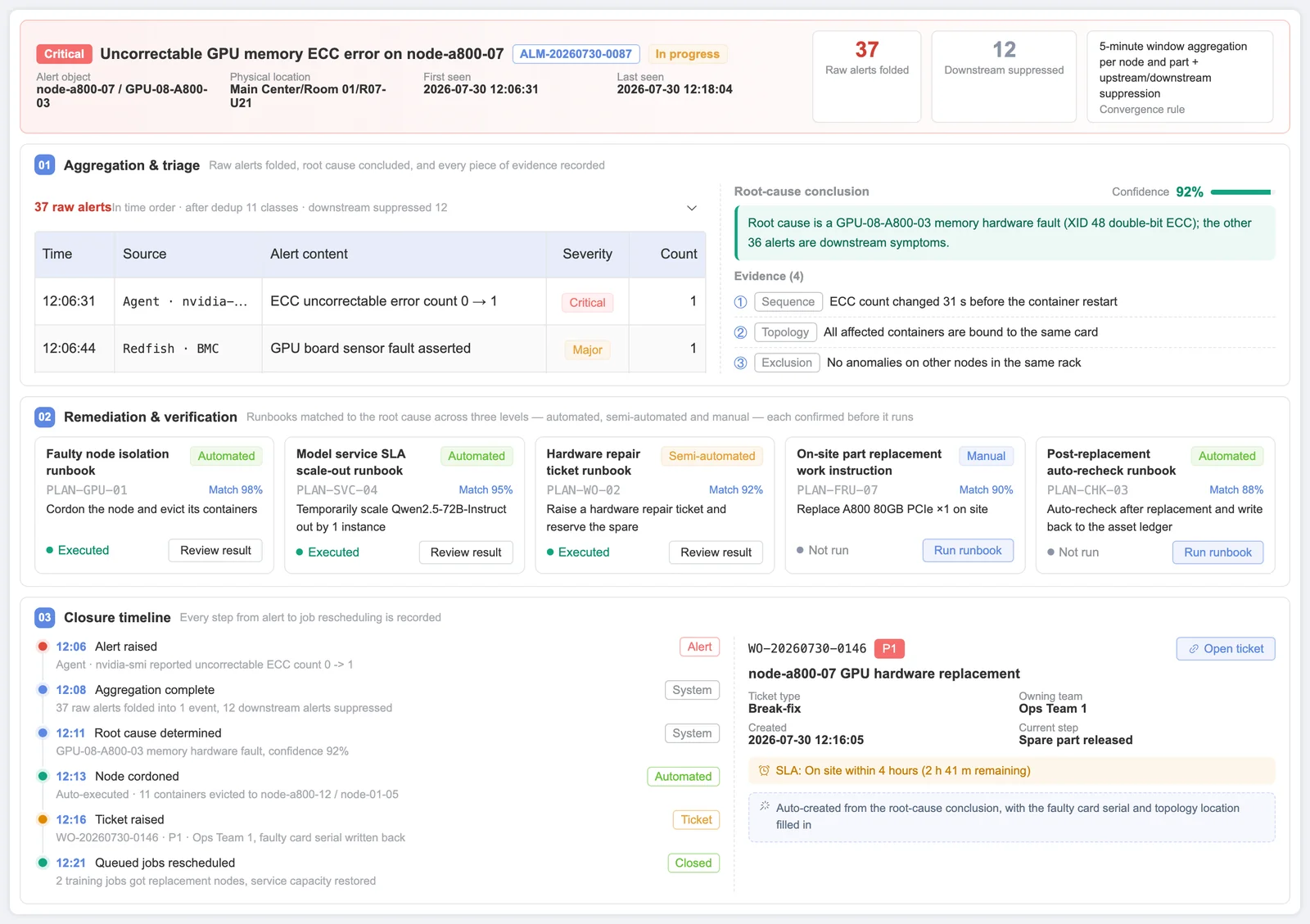
- Events to tickets, with context. A correlated event should reach the service desk with the affected job, tenant, service and owner already attached, so routing and priority are right from the start.
- Configuration items and relationships to the CMDB. GPUs, nodes, clusters, pools and racks as configuration items, with the links between them and up to the services and owners they support. This is what lets change and impact analysis reach the AI estate.
- Usage to finance. GPU-hours and token usage by project and tenant, so chargeback and budgeting use measured figures instead of an even split.
- Alerts to on-call. Correlated alerts, not raw ones, to the paging and chat tools the teams already use, with routing by severity and team.
Each flow has a consumer who notices when it is missing. The service desk notices the first time an AI incident bounces between three teams. Change managers notice when a storage change interrupts a training run nobody had listed. Finance notices when a department disputes its share of the cluster cost. Asking each of them what they would do with the data is a quicker way to set priorities than an integration roadmap drawn up by the AI team alone.
The southbound side matters too. If part of the capacity runs in public or private clouds, reading their metrics into the same view means on-premises and cloud capacity are counted with the same definitions.
How Sensaka handles it
Sensaka for AI Data Centers uses its AI infrastructure CMDB as the shared data foundation for monitoring, scheduling, metering and alerting, so the records that go north are the same ones operators use every day. Alerts are correlated into events with root cause and impact analysis before they leave the platform, which keeps the service desk from receiving one ticket per symptom.
Sensaka includes its own workflows, tickets and CMDB, and syncs with ServiceNow or Jira when those are your system of record. Correlated alerts can go to PagerDuty, OpsGenie, Slack, Jira, email or a webhook. On the cloud side, Sensaka reads resources, capacity, performance and alarms from AWS, Microsoft Azure, Google Cloud, OpenStack and VMware at the metrics level; it is read-only, and provisioning stays in each cloud's own tooling. The AI platform integration page lists the interfaces in detail.
Decide who owns each record
Integration projects often stall over ownership. Before connecting anything, agree for each class of record which system is authoritative. A workable split for many organizations: the AI operations platform owns hardware facts it discovers (model, serial number, firmware, component health, accelerator inventory) and live relationships to jobs and pools; the enterprise CMDB owns business services, owners and support groups; the ITSM tool owns the ticket once it is created.
Then start small. Events to tickets with context is usually the quickest flow to show its value, because it changes how fast the right team picks up an incident. CMDB sync and usage reporting follow once the field mapping is agreed. Control-level automation comes last, if at all.
Frequently asked questions
What is northbound integration?
Northbound integration is how an operations platform hands data to the systems above it, such as ITSM, the enterprise CMDB, finance and on-call tools. Southbound integration is how it collects data from the devices, controllers and platforms below it.
Why should AI infrastructure data reach the enterprise CMDB?
Without it, change and impact analysis stop at the server. With GPUs, nodes, clusters and pools as configuration items linked to services and owners, the CMDB can show which AI services a change or failure affects.
What is the difference between metrics-level and control-level integration?
Metrics-level integration shares data: inventory, alerts, usage and capacity. Control-level integration lets one system ask another to provision, change or reclaim resources, with approval, audit and write-back. Control-level is harder and usually comes later.
The AI platform integration page covers the interfaces, and the AI infrastructure CMDB and GPU usage metering pages cover the records and usage figures that flow north. All are part of the Sensaka for AI Data Centers. Test the integrations against your own service desk in a free 30-day on-premises pilot, see list prices on the pricing page, or resell the platform through the partner programme, which pays a 25% margin in the first year.
Send GPU events to your service desk with the job, tenant and owner attached. Start a free 30-day pilot on your own hardware, inside your network.
Start a Pilot →Sensaka for AI Data Centers
GPU pools, workload queues, GPU-hour and token metering, and an operations cockpit with an AI Cockpit, on one on-premises platform.
Related articles & analysis