
Running AI Infrastructure On-Premises in the EU: Data Residency, EED Reporting and Sovereignty
European operators have good reasons to keep AI infrastructure on their own floor: sensitive data, customer contracts, energy reporting and a growing preference for control over where the work happens. That choice also applies to the tools that run it.
Much of the public discussion about AI infrastructure is about hyperscale clouds. In Europe much of the practical work also happens elsewhere: enterprises, research institutions, colocation providers and regional operators building their own AI factories, often on-premises, often for data that cannot leave a given site or country.
This post sets out the operational side of that choice: why data residency covers the operations data as well as the training data, what Energy Efficiency Directive reporting needs from the stack, how NIS2 and the EU AI Act shape the evidence operators keep, and a checklist for the operations platform itself. It explains operating practice; it is not legal advice, and your obligations depend on your sector, size and role.
Why on-premises is back on the table
The reasons European operators give are consistent. Training data and fine-tuned models are often among the most sensitive assets an organization holds. Customer contracts, particularly in finance, health and the public sector, frequently specify where data may be processed. Energy reporting rules make power and cooling data a compliance matter. And there is a broader argument about sovereignty: keeping control over the infrastructure that critical services depend on, including who can switch it off or change its terms.
None of this rules out cloud capacity. Many operators run a mix, with sensitive training and inference on their own floor and burst or development work elsewhere. But the on-premises part is growing, and with it the need to operate it well without exporting its data to do so. Our post on the local AI data center story covers the vendor side of the same shift.
Data residency covers the operations data too
Residency discussions tend to focus on training data and model weights. Operations data deserves the same attention. Hardware telemetry, inventory, network maps, job names, tenant names, tickets and the questions people type into an assistant all describe the infrastructure and the people using it. Tickets and logs often contain personal data, which brings the GDPR into scope. A monitoring tool that ships all of that to a vendor's cloud has moved part of the AI factory's data out of the building.
Sensaka for AI Data Centers deploys on-premises. Hardware telemetry, metrics and configuration data stay inside your environment and are not transmitted to Sensaka, to Mustard Seed Solutions or to any third party, and the platform does not phone home. The AI Cockpit matches questions against preset operating questions locally and calls no external model, so the questions and answers stay on site too. Data leaves only through integrations you configure, such as a ticket sync or an alert to your paging tool, as described on the AI platform integration page.
EED reporting needs facility and IT data together
The recast Energy Efficiency Directive, Directive (EU) 2023/1791, requires data centers above a size threshold to report energy and sustainability data to a European database, with the reporting scheme set out in Delegated Regulation (EU) 2024/1364. As our EED reporting overview explains, the obligation applies to facilities with an installed IT power demand of 500 kW and above. Some member states add their own rules on top; Germany's Energy Efficiency Act (EnEfG) is the best-known example. The EU EED glossary entry summarizes the terms.
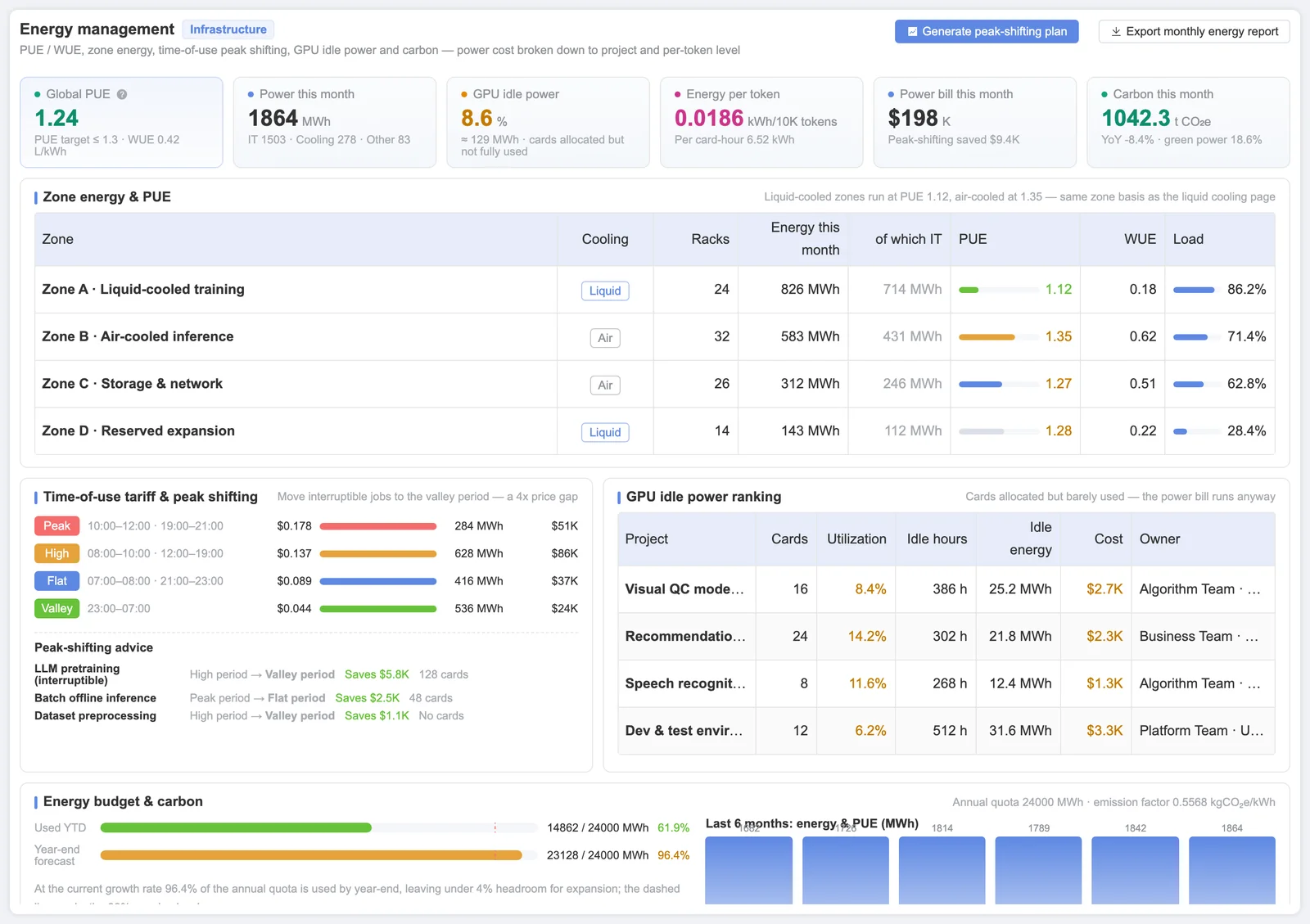
For an AI factory, the practical difficulty is that the figures span two worlds. Energy and water come from facility equipment; IT load and utilization come from servers and GPUs. Collecting both in one platform, with the same timestamps, removes most of the manual work at reporting time. Sensaka tracks PUE and WUE in real time and as trends, compares liquid-cooled and air-cooled zones, and attributes energy by project and per token, which also gives operators a defensible way to talk about the energy cost of AI work.
NIS2 and the AI Act: the evidence operators keep
NIS2, Directive (EU) 2022/2555, applies to a wide range of essential and important entities, and data center service providers are among the sectors it names. For organizations in scope it requires cybersecurity risk-management measures and incident handling and reporting. In operational terms that means knowing what you run, detecting incidents, and being able to show a timeline of what happened and what was done. An accurate asset inventory read from the hardware, correlated events with root cause, and tickets that record each step all make that evidence easier to produce.
The EU AI Act, Regulation (EU) 2024/1689, places most of its obligations on the providers and deployers of AI systems rather than on infrastructure operators. Operators hosting those systems are still likely to be asked by customers for supporting information: where a workload ran, on what hardware, and what changed. A platform that keeps job-to-hardware relationships and change records in one place answers those questions without a special project.
A checklist for the operations stack
When the AI infrastructure is on-premises for residency or sovereignty reasons, the tools that operate it should meet the same standard. A short checklist:
- It runs inside your network, with no required outbound connection to the vendor.
- Any AI features run locally, without sending questions or data to an external model.
- Data leaves only through integrations you configure, to destinations you choose.
- Facility and IT energy data are collected together, ready for EED reporting.
- Inventory is read from the hardware, so it can be trusted as evidence.
- Events, tickets and changes are recorded with timelines and owners.
- The vendor's legal entity and support sit in a jurisdiction your procurement team accepts.
On the last point: Sensaka is a product of Mustard Seed Solutions Sp. z o.o., registered in Warsaw, Poland, an EU member state.
Frequently asked questions
Does data residency apply to monitoring and operations data?
It should be treated that way. Telemetry, inventory, tickets, logs and assistant questions describe the infrastructure and its users, and tickets and logs often contain personal data. Keeping the operations platform on-premises keeps that data on site with the rest of the AI factory.
Which data centers must report under the EU Energy Efficiency Directive?
Under the recast Directive (EU) 2023/1791, data centers with an installed IT power demand of 500 kW and above report energy and sustainability data to a European database, following Delegated Regulation (EU) 2024/1364. Some member states, such as Germany, add national rules. Check your own obligations with counsel.
Does an on-premises AI operations platform need internet access?
Sensaka does not. It deploys on-premises, does not phone home, and its AI Cockpit matches questions locally without an external model. Outbound traffic happens only through integrations you configure, such as a ticket sync or alert routing.
To see how the operations stack for an on-premises AI factory fits together, start with the Sensaka for AI Data Centers page, then AI operations cockpit, liquid cooling monitoring and AI infrastructure CMDB. A free 30-day on-premises pilot runs inside your network with no data leaving it, list prices are on the pricing page, and EU integrators can resell the platform through the partner programme with a 25% first-year margin.
Run the operations platform inside your own network, with no external model and no data leaving the site. Start a free 30-day on-premises pilot.
Start a Pilot →Sensaka for AI Data Centers
GPU pools, workload queues, GPU-hour and token metering, and an operations cockpit with an AI Cockpit, on one on-premises platform.
Related articles & analysis